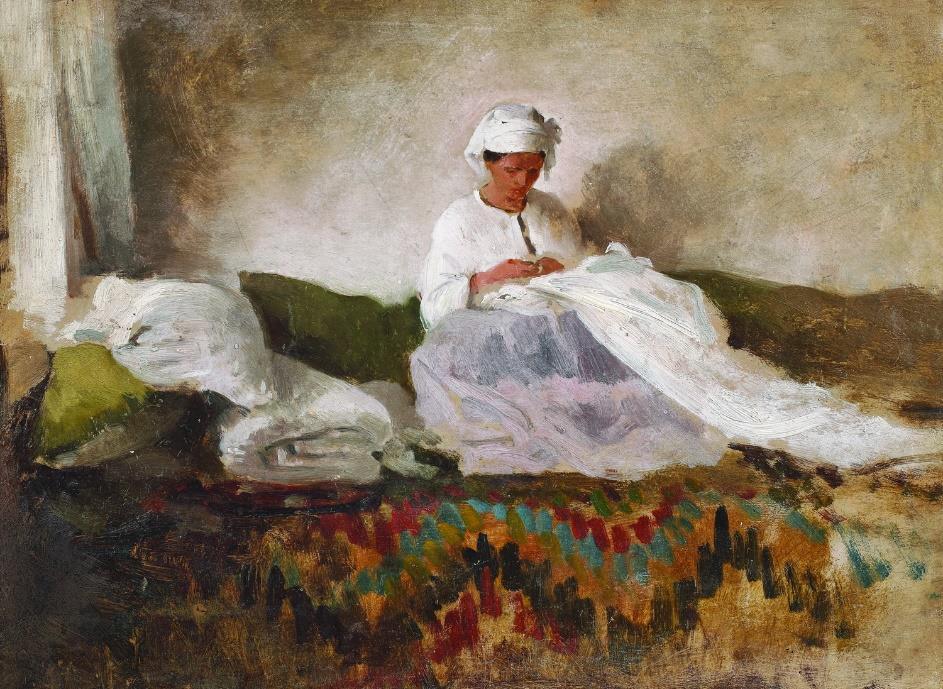
Originally reproduced by Vlahuţă in the Grigorescu monograph from 1910, with the name Sewing (Au travail, in the French edition, 1911), the work reappeared in the interwar bibliography with titles easily differentiated between them. In 1956, in the study N. Grigorescu. The apprenticeship Years by G. Oprescu – R. Niculescu, the title also includes the name of the model: Maria Ghigorț Sewing. The catalogue of the Artmark sale of December 2019, records the work under the name of Seamstress.
The protagonist of the image, Maria Ghigorț, the artist’s sister, was the first child of Ruxanda and Ion Grigorescu, of the six including the future painter2. Born in 1830, Maria married at the age of 13, thereafter bearing her husband’s name. She seems to have died relatively young, according to the same study where the photo of the Ghigorț couple is reproduced, in which Maria appears elegantly dressed in taffeta dress, with a crinoline3, as was the Second Empire fashion.
Grigorescu pictures her around the age of 40, sitting on a sofa covered by a Wallachian carpet with geometric decor. In the centre of the composition, Maria is seen from the front, holding her head slightly bent over her needlework. The face and the sewing hands are treated in summary, as the artist knows how to record with a very sure economy of means, the fineness of the facial features and the suggestion of agility of the fingers in the hands, practiced in the sewing exercise. She is dressed in home attire, with a scarf tied on her head, as the peasants and boyars from the country used to wear around 1800 – 1850, a way of covering the head that is found in the painting of votive portraits from the village churches of Oltenia, from the late 18th century and beginning of 19th century.
Conquered by the picturality of the scene that reality offers, Grigorescu harmonizes sumptuous, pure and colourful dialogues of whites that respond to one another in the space invaded by daylight: Maria in the middle, a silhouette cut out against the wall, surrounded by white waves of linen; above the carpet – a decorative field of geometry and colour – a scaffolding of whites and greys dominating the composition. An element dynamizing the image, the white cloth of the needlework flows to the right, reverberating in the light.
Throughout his work, Grigorescu returned to the subject of this genre scene in variations on the same theme, combining the study of light (mainly) with the portrait sketch (in the subsidiary). This is an entire chapter of works that could be classified in three cycles:
1. The cycle of realistic vision in which observation and rendering prevail, sometimes with ruthless accents, detectable especially during the Barbizon period (Old Woman Mending, 1867, MNAR/GARM inv. 3322).
2. The Vitré interiors (1876; c. 1881 – 1885) where the sunlight that bursting in from outside plays the main role; the construction of the shape through vivid and synthetic strokes contribute to the expressiveness of the defining elements for the female character (Breton Woman Working / At the window, MNAR/GARM inv. 67721/7015). This work, dated 1870, makes the transition to the cycle of the Vitré interiors.
3. The third cycle, towards the end of the work, consisting of the works for which Maria Danciu posed at Posada and Câmpina (Sewing, MNAR/GARM inv. 82460/9332), outlines a universe in which light and darkness coexist in a dialog impregnated with melancholy.
Two preparatory drawings were related to this work: One kept at the Academy Library /The Cabinet of Prints4 and another, located at MNAR / The Cabinet of Srawings and Engravings, Peasant Woman Sitting, dated 1870, exhibited by Remus Niculescu in 1957 (cat. 307, bd XLVI).
Orig.: Ion G. Ionescu-Quintus Collection (1875 – 1933), acquisition from the artist’s workshop, Câmpina, c. 1905 (according to the descendants’ confessions); Maria and Ion Ionescu-Quintus Collection, Ploieşti; Mircea Ionescu- Quintus Collection (1917 – 2017), Ploieşti; Ionescu-Quintus Family.
1 Restoration sheet, Ioan Sfrijan, 06/08/2021, Senso Gallery archive.
2 Information provided by Maria Chihăescu, a descendant of Maria Ghigorț, see Oprescu – Niculescu 1956, p. 26, note 2.
3 Ibidem; see also Oprescu [– Niculescu], 1961, vol. 1, p. 18.
4 Ibidem.