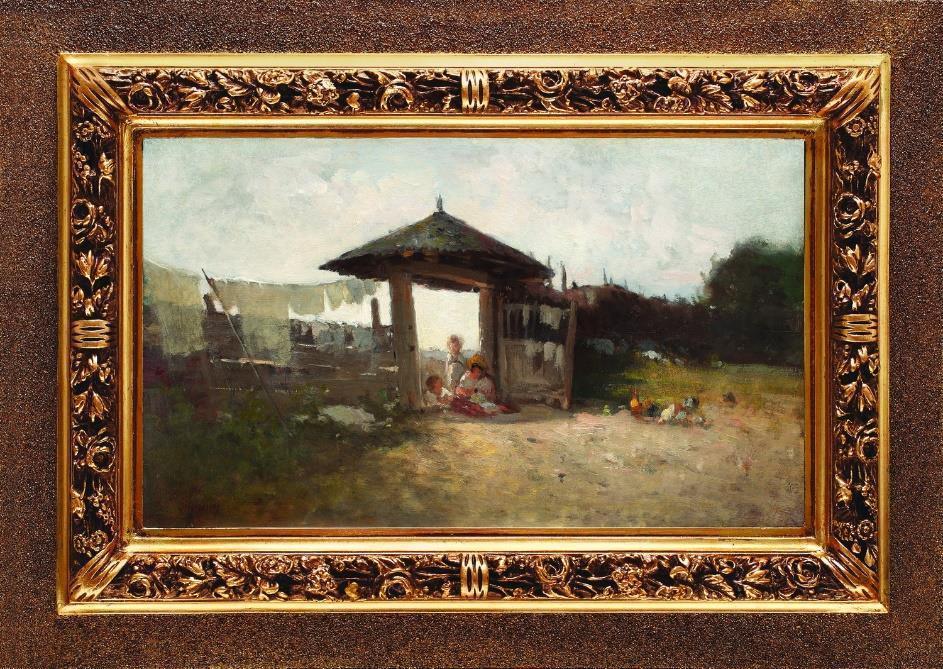
The rough, unidealized character of the rural subject – a wooden gate, a tottering fence and a group of characters (mother with children) sitting on the ground, at the threshold – suggests the period in which the work was painted, when the artist had not yet departed from his option for realism which he asserted in the French School ambiance. Its dating in the 70s is also supported by the larger signature, differentiated from the one that is better known to us, small and calm toward the end.
The artist finds the French rural themes that he adopted in his art at Barbizon and Marlotte in a different range, in Romania. Here, Grigorescu is in the “documentation” phase on topics and themes from the countryside realities in Romania, which will become the original essence of his future work. The wooden gate with a hip roof is one of the elements of popular architecture which the artist now records, being illustrated in other paintings or in a pencil drawing, Gate in the Countryside reproduced in the monograph published by Vlahuță (1910, p. 250). The theme of the peasant woman at the gate is not as frequent with Grigorescu as are other rural scenes. A masterpiece of maturity, Girls Working at the Gate (MNAR/GARM, inv. 3320), dating back to 1888 – 1895 offers a completely different compositional solution by introducing as the main motif the leafy landscape, which filters out the summer light, covering the entire image.
This painting descends from the Barbizon-type view, by using strong contrasts between concentrated, sometimes dark materiality areas and those brightly lit by the summer sun, plus the sky. “Earthiness” dominates the quantitative and expressive strip of sky sprinkled with round whitish clouds and the large white spot spread out in the centre. Rendered in juxtaposed, dense, rhythmic strokes, the soil, as well as the informal background of vegetation (on the right) reminiscent of the Corot’s vision and technique, are the expression of a mastery over the already practiced means of expression. The artist’s mastery in suggesting the human form through a unique spot, laid at the top of the brush, is evident in the modelling of the group of characters from the framework of the gate, a modern, rural motherhood in Grigorescu’s vision. The pictorial beauty of the enlarged detail becomes revealing.
Orig.: Lucia and Dr. Nicolae Ionescu Collection, Bucharest.