In May 1877, with the declaration of the independence of the Romanian state, Nicolae Grigorescu was invited by Prime Minister Ion C. Brătianu (at the initiative of Dr. Carol Davila) to join the General Headquarters of the Romanian Army as a war reporter. Along with other artists – C. Popp de Szatmay, Sava Henția, G. D. Mirea – he was tasked with creating drawings and paintings picturing “movements of our army, particularly the bulk crossing of the Danube”1. Being in Paris, he immediately returned to the country, taking up his mission. Under these circumstances, the artist created an extremely valuable chapter of his graphic and painted work, which determined the very personal setup of his mature style.
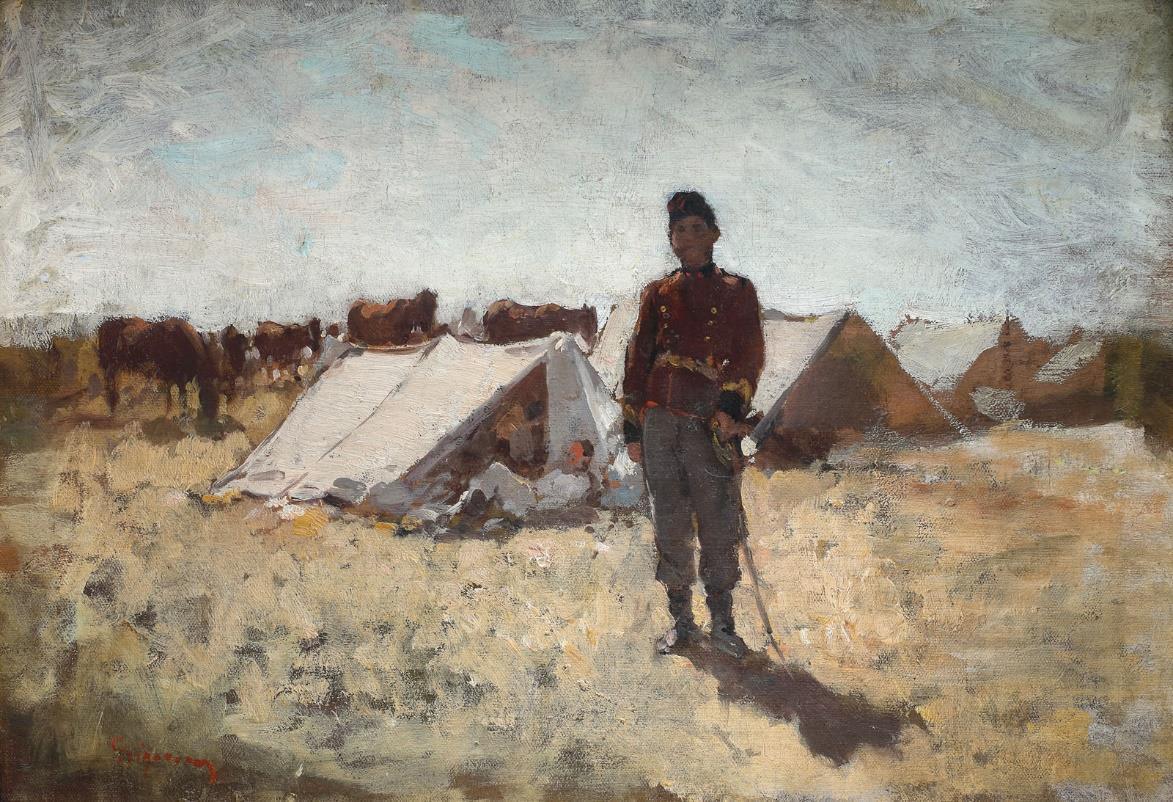
Having the force and the emotion of the painted sketch, quickly executed in front of the motif, this work is among the works created by Grigorescu directly, on the front in 1877.
The artist chose to render in the landscape of the Danube Plain a scene from the army life in which he presented together the human and the animal element, pieces of the camp are present. He first noted the surrounding characters, situations and physiognomies, all bathed in the sunny light of an afternoon, probably in autumn.
In the forefront, a cavalry officer dressed in his specific uniform is captured in the mission to watch over the sleep of his superior – perhaps a Russian high-ranking officer, judging by the long silhouette and the model of the boots. At the same time, the cavalry officer “poses” for the artist, leaning on the sword. Grigorescu knows, as always, to synthetically, with two strokes of the brush, the face of the sentinel (the young, round face), which can be well read by magnifying the detail. Behind the character are tents and horses. The recorded time of the atmosphere is the apparent state of silence before “the storm”. Placed in ample, feverish dabs, the pictorial matter is concentrated in two dominant chromatic areas: the warm ochre of the earth radiating from the sunlight (see the shadow of the sentinel) and the cold shades of grey and coloured whites, of the blue sky. The materiality area with the muddy, wrought-up earth takes up more than half the height of the work, giving the physical sensation of weight and pressure. Above the scene, the multitude of clouds in the shape of pecorelle (sheep), with azure patches of clear sky, seems to move rapidly, contributing to the feeling of the inexorable passage of time, of tension in waiting.
The work is recorded and catalogued in the Remus Niculescu archive.
1 In Răsboiul, 30 July 1877, quoted by Remus Niculescu in “N. Grigorescu in the memories and correspondence of Alfred Bernath”, SCIA, volume 12, No 2/1965, p. 236