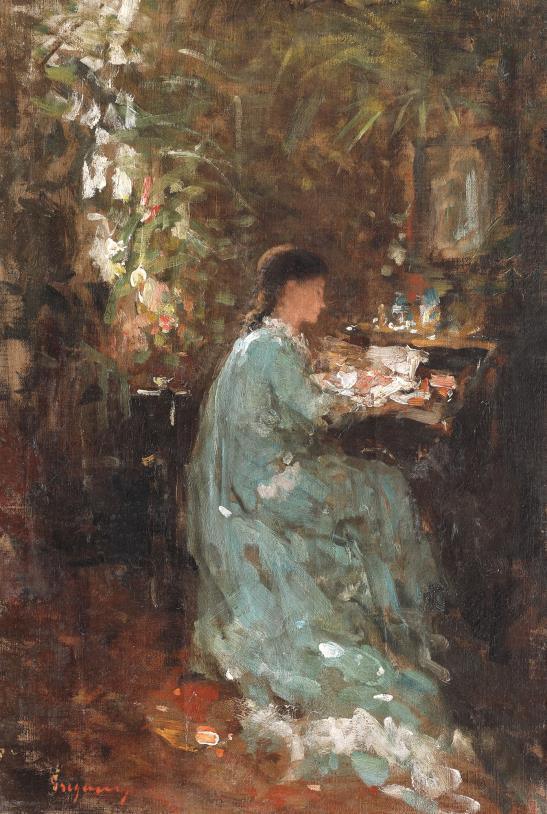
This painting comes from the collection of interwar politician and diplomat Viorel Virgil Tillea (1896, Sibiu – 1972, London), plenipotentiary minister of Romania in London between 1938 and 19401, collaborator of King Carol II in the field of foreign policy. The work accompanied the diplomat’s descendants in their exile in Australia. As far as we know, this painting was not published until recently, when it appeared in the Artmark catalogue of the sale on 29 March 2023.
Unlike the photographs of Queen Elisabeth, her portraits painted by Franz von Lenbach, Nicolae Grigorescu, George Healey etc. now few are still known to the Romanian public, thus respecting the express desire of the royal model not to be exhibited, as Garbiel Badea-Păun informs us in the monograph he consecrated to Romania’s first Queen2.
The work from the Anca Vlad collection reminds us of Nicolae Grigorescu’s sustained relationship with the ruling family of Romania, over the decades. In the Exhibition of the Friends of Beaux-Arts of 1873, Prince Carol and Lady Elisabeth were already present with their collections of Grigorescu paintings (made at Barbizon and in the country), collections already set up in a first stage. The admiration that Elisabeth always showed Grigorescu, considering him the national artist, determined the increase of her own collection, as evidenced by the correspondence received by the painter from the royal court, an archive studied and partially published by George Oprescu in 19443. Elisabeta purchased “valuable works every time the artist exhibited” (Badea-Păun 2003, p. 198).
Variants of the work
In my opinion, this painting is a variant – in a freer, more abstract and summary treatment – of the original, homologous work, entitled La princesse Elisabeth de Roumanie, dance son cabinet de travail, being registered under Grigorescu’s name in the catalogue of the Paris Salon, in May 18804. Surely commissioned by Lady Elisabeth in 1879, the painting made its first appearance in Paris in the consciousness of a well- informed European audience, as the annual exhibition from the capital of France, the supreme court on the matter, brought together artists from all over the world based on a strict selection. The portrait of Elisabeth painted by Grigorescu was seen by the couple Carol – Elisabeth as the preamble of the essential political event for the Romanian Principalities, which would take place in a year (May 1881), the proclamation of the Kingdom of Romania. The catalogue of the Paris Salon provided the title of the work and its size. However, the painting was not included in the illustrated catalogue of the exhibition.
The first published image of the work and the information that it belonged to the queen appeared three decades later, in 1910, in the monograph dedicated to the artist by A. Vlahuță5. What is clearly evident from the comparison of the two catalogue sheets (the one from the catalogue of the Paris Salon, 1880: 1.15 x 0.85 m; the one from Vlahuță’s monograph, 1910: 0.66 x 0.48 m), is the fact that we are dealing with two different works, both from Elisabeth’s collection. The painting having the greatest size was, of course, the work commissioned by Lady Elisabeth, the “the top of the range” of the several variants which we can assume Grigorescu created. Vlahuță’s work reappeared reproduced in the monograph Grigorescu by Virgil Cioflec (1925), with the title Queen Elisabeth (catalogue 39), with only one mention, that of the fact that it belonged to the Royal Palace Collection.
The first work of the series, the one exhibited in Paris in 1880, was, we believe, kept uninterruptedly in the royal family of Romania6, and is today in the collection of Her Royal Highness Margareta, Custodian of the Romanian Crown. It is probably the one reproduced in 2003 by Badea-Păun on the cover of the quoted monograph. The same work features a much better image in colours in the volume Royal Portraiture. Art and Memory (coord. Narcis Dorin Ion), edited by the Peleș National Museum in 2020. Although the sizes are missing in both cases, we assume that the work reproduced in 2003 and 2020 respectively is the larger one, present in the catalogue of the Paris Salon of 1880.
A third version of the author was at a crossroads for centuries in the collection of Colonel Jacques Lahovary, later General Lahovary. Brief details about this work (its title, the name of the owner) are provided to us by the catalogues of two exhibitions: Paris, 1889 and Bucharest, 1906. However, we do not know its size and image. We are speaking of La reine Elisabeth de
Roumanie appearing in 1889 in the Universal Exhibition in Paris (cat. p. [261], Roumanie/Grigoresco No. 4) and then, in 1906, of the same, Portrait of Her Highness the Queen (working in the workshop), a painting presented by Grigorescu in his retrospective at the Jubilee Exhibition in Carol Park (cat. p. 490, No. 13).
The author’s variations of this series are part of the artist’s working system, as well as a theme that he always revisited, that of the intimist genre scenes, interiors with a feminine presence creating melancholy. The models were different: Lady Elisabeth; the unknown grace seen from behind, perhaps the soprano Carlotta Leria; Maria Danciu, the artist’s favourite model and the mother of their child. In these images, the lighting direction determines a state of mind that does not exclude the realistic observation of the elements defining the ambiance.
This work
The painting from the Anca Vlad Collection it could be a working variant or a return by Grigorescu, perhaps a response to a request coming from the royal entourage.7 It indicates the mature style of the artist around 1880 and immediately afterwards, expressed in dynamic, flickering strokes that scan the surface of the painting, providing vibration, unity and sometimes emphasizing materiality. Through the typology of great freedom of the employed means of expression, this work is closer to the condition of a rapidly painted sketch, without external constraints, than it is to a commissioned work, intended for an official character, completed in several stages in the workshop. This painting bears on the back side the stamp of the merchant of painting articles Hardy – Alan, a merchant to whom Grigorescu resorted in various stages of his creation, starting from his early period and later in the years 1870 and 18808.
Elisabeth of Wied (1843 – 1916), Lady Elisabeth at that time, the future Queen of Romania – is represented in the centre of the image, working in her office around 1879 – 1880 in the princely houses from Cotroceni. Grigorescu pictured her in a stance that she loved, that of a painter of miniatures, of illuminations. A diagonal of lights spreads a rain of sparkling strokes from above, a symbol of the moment of grace that presides over the act of artistic creation. The character’s actual image – the face profile, the long hair styled tightly at the back, the slim silhouette, the dress with the princely train – identifies Carmen Sylva9 at a specific moment in her life, between 1879 and 1880. She is surrounded by lush greenhouse plants, not explicit, but suggested by the artist’s free pen. A refined virtuosity of the pictorial gesture contributes to the grace of this feminine silhouette and to the image of the vegetation over which it overflows in an avalanche, lights. Through the evanescent aspect of the strokes in the background, Grigorescu approached the language of his contemporary, Berthe Morisot, perhaps also the memory of the French 18th century, which he had studied closely in the La Caze collection. The same craftsmanship of execution is manifested in the transparency of the diaphanous dress with a veil train extending on the floor towards the forefront. Attentive and sensitive to the show of the surrounding light, Grigorescu appealed to powerful effects of light contrasts that combine with the gestures of the brush stroke marks.
However, he no longer integrated in the work – as he did in his important paintings – symbolic compositional elements, such as the bust of Princess Mărioara – the only child of the couple Carol – Elisabeth, who died at the age of four – a profile projected on the luxuriousness of the surrounding plants or the still life of great pictorial value (a glass cup, a ceramic pitcher, etc.), on the secrétaire. As if on a deliberate note of modesty, in the work of the royal collection, the character is located in a plane far from the viewer, enveloped in the sadness that is confused with the magic atmosphere of the act of creation. By contrast, this painting can be considered an exercise in the intimate laboratory of Grigorescu’s creation. The painter seems to be less marked by the emotion that the spirit of the model created around him. This time, the artist placed the character closer to his easel (and implicitly to the viewer), and Grigorescu focused not so much on the atmosphere of the scene, but on the plasticity effects of the pictorial matter laid down with ease and force.
Photographs of Lady Elisabeth toward 1879 – 1880, dressed in a dress with a train, published by N. Iorga in his volume Portraits of the Romanian Ladies (Comisiunea Monumentelor Istorice, Bucharest, 1937, fig. 75, 77, 84) testify to Grigorescu’s respect – a painter intertwining the vocation of realistic observation and the lyrical load – of the data and atmosphere offered by the image of his princely model in the environment of her office.
Orig.: Viorel Virgil Tillea Collection, Bucharest; the descendants of Viorel Tillea, Australia.
1 Gafencu 1991, p. 172-173 ; http://www.bcucluj.ro/en/maimult.php.
2 Badea-Păun 2003, p. 137.
3 Oprescu, “Corespondența”, 1944.
4 Explication des ouvrages…, 1880, Paris, cat. 1698: Grigoresco (N.), né à Bucharest.- A Bucharest, et à Paris, boulevard de Clichy, 1. 1698 – La princesses Elisabeth de Roumanie dans son cabinet de travail. / H. 1.15 m – L. 0.85 m.
5 In the monograph by A. Vlahuță (on p. 259) another work is catalogued, one much smaller (than the one mentioned by the French catalogue): M. S. Regina Elisabeta, planșă fotogravură, 66 x 48 cm, la M. S. Regina Elisabeta.
6 Badea-Păun, 2003, p. 137, note 17.
7 We may ask ourselves whether this work is not the one that was shown in 1889 and then in 1906 in the Jacob Lahovary collection. Grigorescu knew Jacob Lahovary very closely, he had met him in Paris in the 60s, when they were both studying here, they met again on the frontline in 1877, when he drew his portrait.
8 Ioana Beldiman, “Nicolae Grigorescu în Parisul articolelor de pictură” 2021, p. 23-31.
9 The literary pseudonym of Queen Elisabeth of Romania.