One of Grigorescu’s preferred methods of working en plein air and implicitly of studying was the execution of “variations on the same theme”, of variations of the same pictorial motif, each under a different light, to capture the picturality of the fleeting moment of light; also with some differences in size and in compositional, colour details, etc. This was noticed by researchers, without anyone having stopped in a publication, trying to describe the variants, to place it in the context of the era, or to try to catalogue the variants.
Systematically and programmatically, especially in 1880, the Impressionist painters, Grigorescu’s contemporaries (and his former colleagues from 1861 – 1863, whom he encountered in the workshop of Professor Charles Gleyre), elaborated such series through around the 9th decade: Poplars, Haystacks, The Rouen Cathedral by Claude Monet or the series of the Church of Moret-sur-Loing by Alfred Sisley and so on. We can see that the mentioned period corresponds to the mature creation of the Romanian artist who was always aware of what the Impressionists were working and displaying.
This work and its variants – we will refer here to five of them – have as an element of the composition (central or not), the construction of the inn at the end of the 19th century in Orății, not far from Câmpina: “The picturesque settlement guarded the road between Ploiești and Brașov, not far from Posada, where the painter came to work in the summer for several years, starting in 1887” (Remus Niculescu, 1957 apud Vlahuță, 1910).
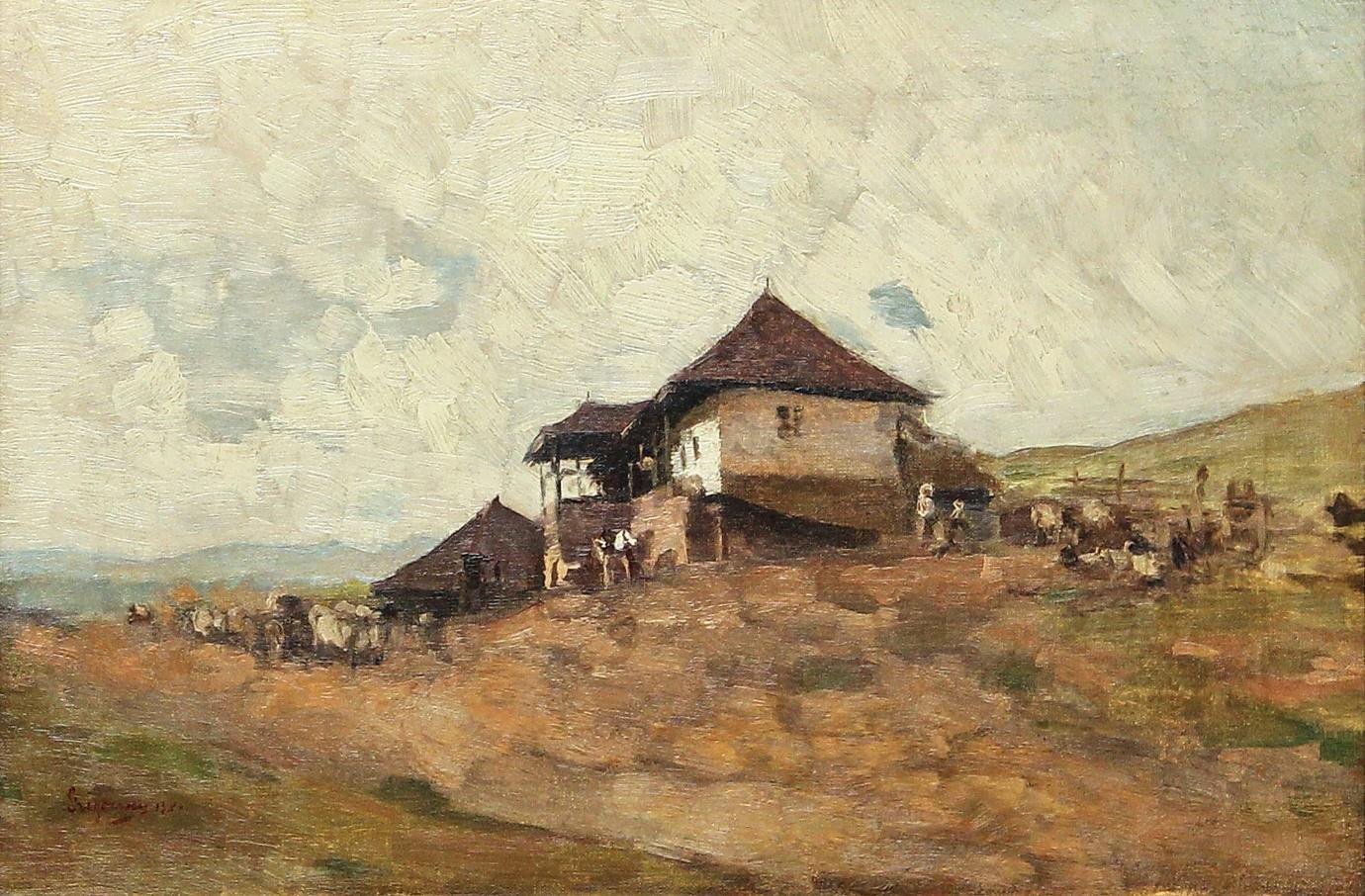
Identifying and analysing “a national subject”, the peasants’ inn, an object of popular architecture, the artist placed his easel at an angle that he considered to be privileged for rendering the motif. He was interested in this vernacular construction, the presence of human and surrounding animals being recorded in miniature, in the subsidiary. In the above-mentioned variants, the angle from which the painter looked seems to be the same, but the distance between the easel and the building is different. We have seen that the artist returned to this place on numerous occasions, approaching the composition each time with some differences, whether smaller or larger. Of the six paintings highlighted in this comment, in three which are similar to one another (those from the following collections: Anca Vlad; MMB – inv. 1468; MNAR/GARM – inv. 93099/10198), the “main hero” of the image is the inn building located in the centre of the composition. Under the sky partially covered by white clouds, the scenes are flooded in a summer afternoon light, with its specificity given by the climate of the Subcarpathian area. The discrete differences between the three works are identified in the dimensions of the works, in colours, in small details, in the form of traces drawn by the brush.
In three other later works, executed around 1900 (all at MNAR, one dated 1901)1, the main element is no longer the building. The front planes are animated by carts with oxen, the inn being in a distant plane, towards the background. The light recorded by the artist seems to be the afternoon light, when the peasants in their loaded carts return from the field.
This work dated 1887 (1887 is also the year of the one from the Museum of Bucharest) was painted at the beginning of the artist’s approach to the motif, obviously even between the first ones, when Grigorescu may have discovered the site and the building with their pictorial potential. His interest may also have arose due to the overlapping of architectural forms and volumes inscribed in geometries: a dark wooden veranda stands out in relation to the prism in the white masonry of the building. The ensemble of the construction noted by Grigorescu for its specificity and harmony was actually an example of the architecture of the Inn in the Prahova area, toward the end of the 19th century. The image became practically a “national motif” in the artist’s creation, an aspect of which he was aware.
In this work, the characters and the animals are details of life in motion, located in the lower part (in relation to the inn) and on the side to the right of the building. A white shirt, dotted with two touches of brush, indicates a male character working. The pictorial matter is placed in visible strokes, of similar size, close together and ordered in masses of colour. In the forefront, the ochre brush strokes indicate a wrought up earth, while on top, the whites and the greys laid in gestures, draw masses of clouds interspersed with patches of sky. The force and rhythmicity of the brush strokes drive the entire surface of the painting into a circuit with a dynamic suggestion.
The work is not reproduced, as far as we know, in the classical publications of the literature on Grigorescu. Due to the compositional similarities and the same 1887 date, the Inn at Orății landscape from the Anca Vlad Collection could be confused, at a glance based only on the quick research of some photos and not on the direct and detailed comparative examination of the works, with the landscape At Orății from the Museum of Bucharest, reproduced in most bibliographic references. The artist’s recording of the year 1887 on the work in Mrs. Vlad’s collection, certifies, in our opinion, that Grigorescu appreciated this canvas, considering it (as well as the one at the Museum of Bucharest), a work of reference for the entire cycle dedicated to the Orății Inn.
Related works
The Tavern of Orății, MMB, inv. 1468. Oil on canvas: 32.5 x 55.5 cm; signed and dated in the lower LH corner, in red: Grigorescu 1887. It is the work most frequently reproduced in the bibliography; Bibl.: Șirato, 1938, bd. XXIV; K. H. Zambaccian [1945], bd. 86, 108; Niculescu, Exhibition 1957, cat. 234; Oprescu 1958, fig. 150, p. 183; Varga 1973, ill. 55, p. 95; Bucharest 1984 – 1985, cat. ill. 254.
Tavern on the Main Road, MNAR/GARM 2022, inv. 93099/10198; Title given by Grigorescu, v. Niculescu, Exhibition 1957, Cat. 235; MNAR/GARM 2022, inv. 93099/10198; Oil on canvas: 30 x 43.5 cm; signed in the lower LH corner, in red: Grigorescu; Bibl.: Niculescu, The 1957 Exhibition, cat. 235; Costina Anghel, Mariana Vida, MNAR/GARM 2022, No 220, ill.
Landscape with Oxen Cart, MNAR/GARM, inv. 66746/6726; Oil on canvas: 0.285 x 0.80 m; c. 1893 – 1900, signed in the lower LH corner, in red: Grigorescu; Bibl.: Costina Anghel, Mariana Vida, MNAR/GARM 2022, No. 390, ill.
Cart with Oxen, MNAR/GARM, inv. 76202/9040; Oil on canvas: 69 x 112 cm; signed and dated in the lower LH corner, in brown: Grigorescu 1901; Bibl.: Costina Anghel, Mariana Vida, MNAR/GARM 2022, No 394, ill.
Carts with Oxen at Orății, private collection, Bucharest (from the former Constantin Angelescu collection, returned in 2020); The work was part of the MNAR/GARM heritage, inv. 1907; oil on canvas: 87 x 130 cm; bottom LH signed in red: Grigorescu; Indicative : Jianu, Frunzetti 1953, p. 98, ill. p. 99; GN [1954], cat. 338; Niculescu, The 1957 Exhibition, cat. 265, bd XXXIX; Oprescu [– Niculescu], 1962 – vol. II, cat. and bd. IX; Oprescu 1963, ill. p. 74 and book jacket.
1Peisaj cu car cu boi, signed, undated, inv. No 66746/6726; Cart with oxen, signed, dated 1901, inv. 76,202/9,040). The composition Care cu boi la Orății, MARSR, inv. 1,907 (0.87 x 1.30 m, signed, undated), shown with an illustration (board IX in colours) in volume II of the Grigorescu monograph by G. Oprescu [– R. Niculescu], 1962, no longer appears in the current Repertoire of the National Gallery of MNAR (ed. 2022), being returned by the museum within the Angelescu collection.