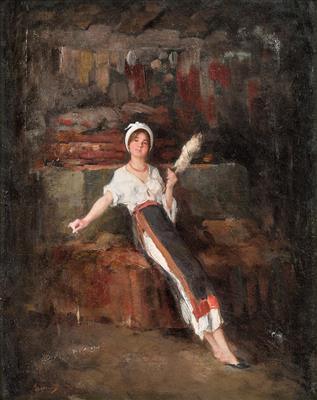
The work was presented in 1906, in Grigorescu’s final personal exhibition, opened at the Jubilee Exhibition in Carol Park, bearing the title Logofătessa with the Dowry of the House and the mention of the owner, Dr. Constantin Istrati. The 109 paintings included in the catalogue were selected and placed by the artist himself. In the previous personal exhibitions, those of 1897 and 1900, the painting A Logofătessa (1897, price 2,000 lei) and, respectively, The Logofătessa had appeared (1900, price 1,000 lei). It was probably the one that would be exhibited in 1906 with the full title and later reproduced as a colour board in The Minerva Calendar, of 1908.
Through this painting, we enter the laboratory settling the national themes which preoccupied Grigorescu even before returning to the country after his studies, in his ambition to set up a Romanian art school. The existence of a specific character of artistic creation was a problem that reflected the ambitions of our elites during that period (not just of the artistic ones), in the years 1870 and later, after the proclamation of the Kingdom of Romania (1881), in search of an expression of their own identity.
We can consider this work as a preparatory phase for one of the most emblematic paintings of the national theme: Girl with Her Dowry, painted by Grigorescu toward the end of his mature years, around 18901. However, the reason that became classically specific for Grigorescu, that of the young peasant spinning yarn, already existed in the artist’s creation in 1869, as noted by the professor of aesthetics and his former colleague from S. Cornu’s workshop, Constantin Stăncescu, when he visited his workshop2.
Constructed vertically, the work depicts a wealthy peasant house interior – of the boyar and his wife – a house decorated with carpets, with homemade rugs, displayed in sight, dominated by browns and reds. At the centre of the image is the young wife spinning yarn, an ancient female occupation in the rural world. The dowry of the house, the proof of the woman’s diligence and good taste, as well as of the spinning science, still were, in Grigorescu’s century, according to an archaic tradition, conditions to be fulfilled for the marriage of a girl.
In relation to Girl and Her Dowry, we notice in this work not only another placement on the page, but also the dominant character of the painted sketch in which shapes and volumes are created in synthetic, summary strokes and not by detailed descriptions, as was the case upon rendering of some pieces from the ethnographic props of Girl with Her Dowry, such as the chest from Brașov or the rug from Oltenia which covers it. The vine silhouette of the young peasant no longer evokes the realism of the Barbizon School, it is now Grigorescu’s emblem, the composition of the graceful character being supplemented by the fineness of the fingers which skilfully rotate the spindle, or the slender foot. But the rounded, precisely individualized face and the slightly ironic expression of gaze remind us of the artist’s relentless spirit of psychological scrutiny, specific to his portraits. We have before us the invention of the national artist, his model of feminine beauty in our country, which he decanted and idealized and which he has adopted in his art, without giving up the direct observation of reality. Adorned with red coral beads and with her head wrapped in white, the graceful feminine presence in the centre of the work radiates light through the whites of the clothing contrasting with the surrounding penumbra.
Logofătessa with the Dowry of the House presents herself in her richly decorated French frame, the one that the artist designed for it. The frame was bought from P. Hombert Files, a frame shop located in Paris in the Pigalle district, where Grigorescu had a permanent workshop from 1877 – 1878 until 1894. The address of this store – 37, Rue de Laval – appearing on the label on the back of the frame, changed due to a change of the street name in 18873. This work could be dated ante quem, we believe around 1887. We do not exclude the possibility that it was made in Paris.
Orig.: Nicolae Grigorescu (work documented in 1897, 1900); the collection of Dr. C. I. Istrati, Câmpina or Bucharest (work documented in 1906, 1908, 1914).
1 https://pierre-calvet.fr/carjat-a-hugo-hommage-funebre Remus Niculescu places it in the chapter 1886 – 1895 (see Niculescu, Expoziția 1957, cat. 226, p. 89). It is included in the Grigorescu personal exhibition from 1891, cat. 78.
2 C. I. Stăncescu, “Scrisori de la București”, in Familia, No. 5/1869, p. 609, apud R. Niculescu, “Grigorescu și primii săi critici”, in SCIA, No. 1-2/1958, p. 143.
3 https://pierre-calvet.fr/carjat-a-hugo-hommage-funebre