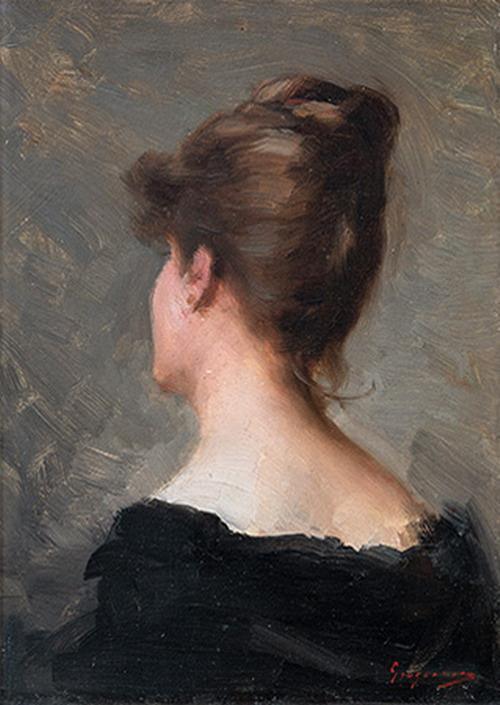
Grigorescu placed his easel behind the charming model, keeping the secret of this physiognomy and relying exclusively on the great finesse of the young silhouette. The barely glimpsing delicate profile, the grave of the curving neck, the elegant updo make this painting a fascinating feminine “portrait” whose face is not disclosed to us. The beauty of the back emerging from the neckline highlights the reflective effect of the black silk dress, perhaps an evening gown.
Sombre due to its option for neutrals, the palette is distinguished through its transparency, as well as through the primness of the painting matter set in quick strokes, apparently disorderly, as if cast while possessed by emotion. The greys and the black respond to one another in musical harmony, emphasized by the bright area. From these sources of aesthetic emotion, the artist creates an atmosphere of intimacy which allows – perhaps in spite of his intentional discretion – his own affective involvement to get through.
The character’s identity is declared at the Ans Azura Auction House which, in 2022, shed light on this work which had been unknown for so long: it is the soprano Carlotta Leria (1857, Iași – 1924, Bucharest), a distinguished personality in the history of the Romanian Opera. As art historian Doina Păuleanu deciphered, through her own research and by interpreting the memories of professor I. D. Ștefănescu, Carlotta Leria was Nicolae Grigorescu’s great secret love1. A significant part of their story unfolded in France, in Paris, probably in Normandy, as well, and in Brittany, away from the indiscretion of the people of Bucharest, in the 1880s, a period corresponding to the pinnacle stages of creation for each of the two artists.
Undated by Grigorescu, this magnificent painted sketch could have been done around 1874 – 1885, an appreciation which takes into account both the biographical moments provided by Doina Păuleanu, regarding other works by Grigorescu which represent Carlotta, and by the model’s young age, which is obvious in this profile’s pictorial suggestion of freshness2.
Born in Iași, she was one of the four Pester-Wirth sisters, related to V.A. Urechia, a historian, a man of letters and minister of Public Instruction between 1881 and 1882. Having the protection of Lady Elisabeth, who would later become Queen of Romania, Carlotta Leria completed her musical studies at the Paris Conservatory, as a student of the famous soprano Pauline Viardot-Garcia(1821 – 1910) and at Milan, with maestro Sangiovanni, followed by an admirable career as a soprano on the opera stages of Turin (1881), Madrid (1882), Madrid, Barcelona (1883), Nice, London (1884)3 and so on. In 1881 she was employed as Prima donna assoluta of the Italian Opera in Bucharest4. Also granted the title of “First singer of Her Majesty the Queen of Romania”5, in 1885 she took part in the birth of the Romanian Opera institution, being the first opera singer in Romanian6. The event was held at the National Theatre in Bucharest, on 8 May 1885, with Linda di Chamounix by Gaetano Donizetti, with Carlotta Leria in Linda’s role, appreciated by the musical chroniclers of the time without any reservations, as was, in fact, the case, every time she appeared on stage in Bucharest7. The journal Voința Națională described on 11 October 1885 the qualities of this soprano voice, as demonstrated in the role of Lucia de Lammermoor: “Miss Leria’s voice, although not very strong, is a voice with a very good ring, equal, with the registers of wonder connected between them and of tremendous sweetness; apart from these qualities, she also has perfect schooling: the hardest vocalizations are children’s games for her.”8
Upon Queen Elisabeth’s request, upon returning to Romania she held concerts either in Bucharest (at the Romanian Athenaeum) or at Iași, Sinaia, Constanța, or Galați. She was invited to the musical matinees held by the Royal Palace in Bucharest by Queen Elisabeth, to the aristocrats’ villas in Sinaia, and, later, to the musical soirees from “Palazzino” of Maruca Cantacuzino, on Calea Victoriei.
In December 1892, bearing the name Leria Zossima due to her marriage9, she was appointed canto teacher at the Conservatory of Music and Declamation in Bucharest, the final name dating from 23 December 189510. She taught the girls’ class, conveying as a the foundations and the secrets of this high profession, until she died.
To our knowledge, the work was not made public until it appeared in the sale from Ans Azura, 2022.
Orig.: The work belonged until around 1950 to princess Maria (Maruca) Cantacuzino-Enescu, born Rosetti-Tescanu.
1 Doina Păuleanu, 2010, p. 55: “we believe that after more than 130 years from the experience of a great love, we can afford ourselves this indiscretion (on behalf of the interested posterity), but without breaking the spell enveloping it”.
2 The date c. 1870 proposed by Ans Azura does not correspond to the character’s registry data, who was 13 years of age in 1870.
3 https://apps.unive.it/project/imla/repertorio/1379 (L’Opera migrante) Accessed on 25/09/2024.
4 “Teatrul italian din București” in Timpul, year VI, No. 202/18 Sept. 1881 (https://www.mihai-eminescu.ro/mihai-eminescu-timpul-anul-vi-nr-202-18-09-1881-pdf Accessed on 01/10/2024).
5 Civis Dimbovicensis, in “Salon”, Familia magazine, year XXI, 1885, No. 15, p. 176.
6 Octavian Lazăr Cosma, Hronicul Operei Române Opera in Bucharest, vol. 1, 1885 – 1921, Ed. Muzicală, Bucharest, 2003, p. 79; see chapters “Fondarea Operei Române” and “Stagiunea 1885 – 1886”, p. 19-123.
7 Ibidem, p. 79-85.
8 Ibidem, p. 92-93.
9 Giving up on her career as a soprano, Carlotta Leria married engineer Dumitru Zossima (1865-1927) a professor at the Polytechnic School in Bucharest and owner of land in Dobrogea. From this point on, Carlotta Zossima devoted herself to teaching canto. See Nicolae Trohani, George Trohani, “Câteva date despre familia Zossima”, in Muzeul Național, XII, 2000, Bucharest, p. 107.
10 ANR, MCIP, file 361/1896, p. 2