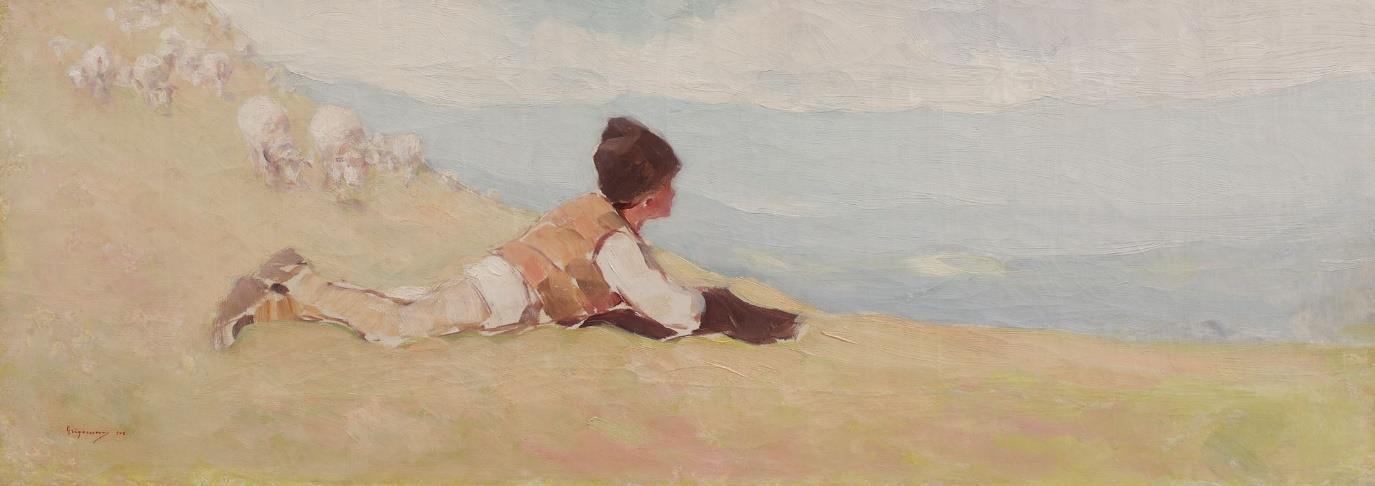
Grigorescu frames this landscape in a horizontal elongated rectangle, a special format that is often found among the artists of the Barbizon School, being suitable for the plein air painting (easy to carry by hand, etc.). The chosen fragment of nature, in which he integrates his model, provides Grigorescu with the compositional solution of two complementary triangles: the earth in the lower left side; the upper right side has the sky and the veiled view of the landscape. The delicate silhouette of the young shepherd pictured lying is partially shaped by the brush, using a broken visual line. Here, Grigorescu’s working method is noticeable: before applying the colour, he briefly sketched the main lines of the composition on the canvas with a brush. He then built shapes and volumes by “modeling” them directly into the pictorial matter.
The work is included in the category of variations on the same theme encountered in another landscape from the Anca Vlad collection, Young Shepherd on Valea Doftanei. This time the character is located at the meeting between the two worlds (earth and sky), looking out at the bluish mountains.
Dated in 1902, therefore belonging to the last fertile interval of his creation, when Grigorescu painted in the surroundings of Câmpina and at Agapia – Văratic, this work could be presented by the artist in his personal exhibition in 1902. In its catalogue, the painting Lying down is registered under number 198 (price 500 lei). A work (the same one?) with a similar but more explicit title, Autumn – Shepherd Lying Down, from the Gogu Iliescu collection was exhibited in 1906 at the Palace of Arts (cat. 69). Neither publication indicates the media and the size. This data would have helped in a potential identification of the work analysed here.
The painting is presented in a richly decorated French frame, probably the one that the artist originally intended.