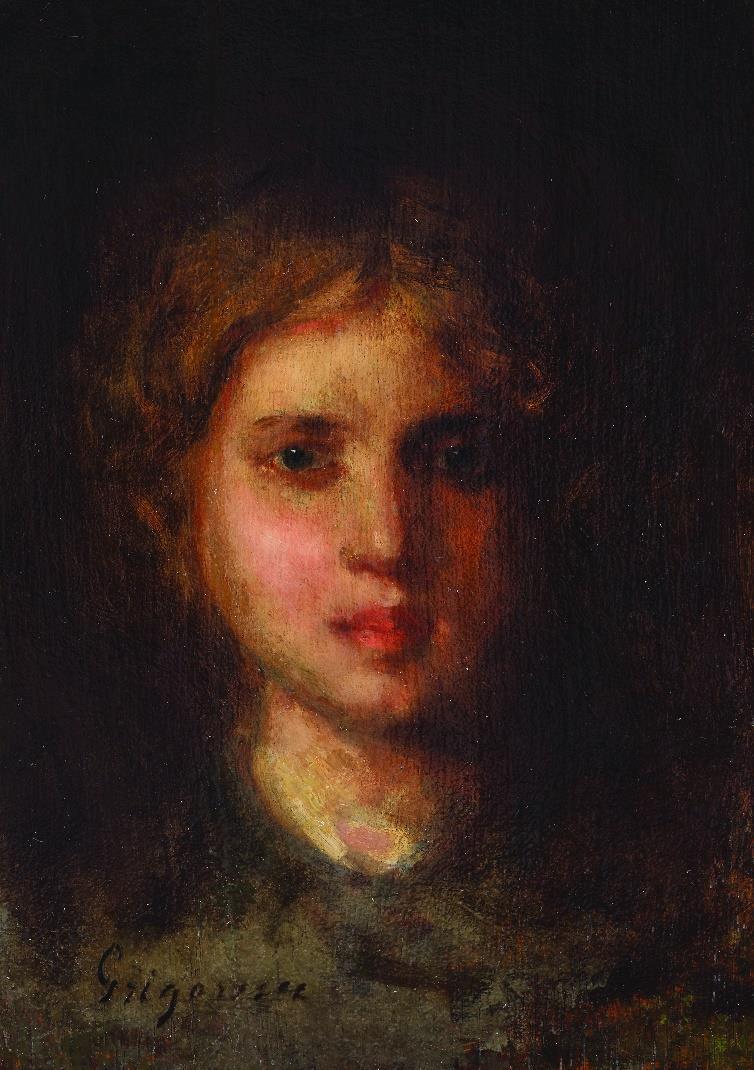
In this “head for study”, Grigorescu highlighted what he learned at the École des Beaux-Arts by preparing the savant test of the Head of expression. This is added to his knowledge of phrenology, a science which, at that time, fascinated the Parisian artistic world and that of the medical students among whom Grigorescu he had friends; moreover, the finesse of his own capacity to investigate the inner life of the model which he had practiced through the extended visits at the masters of the Barbizon School, especially Jean-François Millet, perhaps also of the Palizzi brothers, Neapolitan painters whom the artist may have met at Marlotte. He keenly records the somatic features of this child’s face, the delicate skull with the slightly bulging forehead, the fine line of the face, the thick lips, all connected by a sensible perception into the universe of the purity of childhood.
The sober and dark palette reminding of Rembrandt, heavily used in the 19th century, is the foundation of the expressive contrast between the ensemble and the source of brightness that the figure represents. It refers us to the Romantic Self-Portrait painted by Grigorescu in the years of the Barbizon training (Remus Niculescu, The Exhibition, 1957, cat. 18).
In addition to these contrasts, the character of the signature (its dimensions in relation to the work, the handwriting of the letters slanted to the right and the use of sepia color) also supports Grigorescu’s dating of the painting in the 7th decade.
We do not exclude the possibility that this study was part of the group of portraits created at Barbizon, which Grigorescu presented in 1873 in the Exhibition of the Friends of Beaux-Arts, as his works included several studies of heads, Girl – Study (cat. 206), Girl’s Head (cat. 246) and so on.
The work was restored in 2025 by painting restoration expert Ioan Sfrijan.