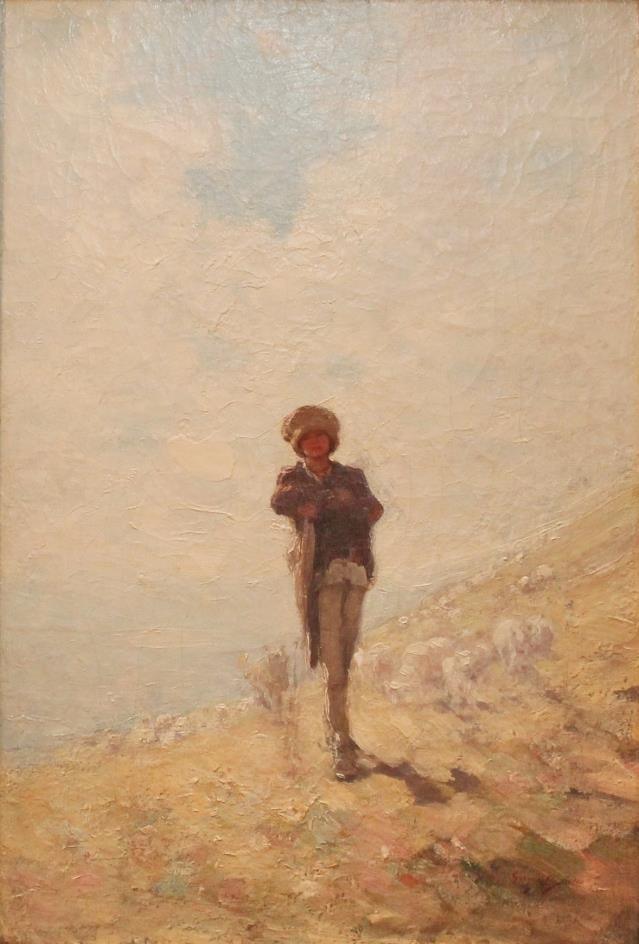
The work is part of the series representing young shepherds with sheep, in a landscape on the hill, variations on the same theme, in compositions organised vertically. They date mainly from around 1896 to the end and belong to the white period1.
Set frontally, almost in the centre of the image, on a hill slope, the standing teenage model projects on the vastness of an open sky with hints of spatial depth covering 3/4 of the image. The sky, the atmospheric air, the midday summer light are exercises in white with which the artist is mainly concerned. The pictorial matter is placed alertly, using a wide brush, next to the palette knife. The light, bright ochre strokes, representing the earth, are parallel, diagonally directed to the lower right corner of the canvas. The face of the model is approached with care, with an emphasis on the delicacy of the figure. The character holds his arms crossed and rests on the staff.
The variants of the series in which this work is integrated are differentiated by size, medium (the wooden one prevails), by several compositional elements such as the hill line, the importance of the sky, the position of the model’s arms, the role of the staff (a supporting element for the character or not), the colour of the sheepskin hat (white or sepia), the distribution of the animal element. Constant elements: the vertical character (in static position) in the centre of the image, summer light at noon or early afternoon. We notice particularly the great similarity between the silhouette and the clothing of the young shepherds in the various variants of the series. We can assume that Grigorescu started from the compositional formula from “the top of the range” entitled Bucegi (Queen Elisabeth’s collection; Vlahuță 1910, p. 137), but conceived horizontally, larger in size, and then opted for the vertical construction required by the character. The variations were then inserted in this formula. He probably often had the same model, maybe even a female model in disguise (Dr. Constantin Istrati remembered this procedure of the painter). The slender silhouette, with straight, slim legs, the round, fine face that we find in these young characters is, as is known, the imprint of the maestro’s personal style. The ideal of the thin, teenage silhouette may have been developed by Grigorescu by processing the data of his favourite model, Maria Danciu, who was as slender and delicate as a vine. We can imagine Grigorescu painting in nature, with the live model before him, idealizing, subsequent.
After a lifetime as a plein air painter, the artist may have returned in the workshop to the essential data of the image construction, but a careful examination leaves us with the impression is that he always resorted to models (and to working in nature) even if only to introduce the small differences. Perhaps, around (or after) 1900, in the case of this series of shepherds, his spirit of observation had been so trained after half a century of work that his visual memory only came to need the model and the outdoors „partially”.
As for the painting of the skies, this was an art which Grigorescu possessed with long-practiced mastery. He had looked at and painted a lot in Normandy, in Brittany (near the ocean), at home in the Subcarpathian area of Câmpina, the image of the moving clouds broken by patches of clear skies, with their suggestions of plasticity, as well as the poetry of the heavens vaulting across the horizon. Representing only a fragment of sky, the MNAR collection includes the painting Clouds (inv. 101546/10450). It refers us to sketches and similar landscapes due to Eugène Boudin, exhibited in this artist’s museum, at Honfleur, near the English Channel.
As certified by two photos published in the dictionary of Contemporary Figures in Romania, by Theodor Cornel and Tudor Arghezi, 1911, this work was then in the house of lawyer and conservative politician Scarlat Carol Arion (1868 – 1937)1, located in the central area of Bucharest, on Corabiei Street, currently 9 Georges Clemenceau Street2. The stylistic ambience was eclectic, as was the fashion of the time in the interiors of the elites. Two paintings by Grigorescu (we recognise this one) were significantly installed, as bearers of national identity, on the wall in front of Scarlat Arion’s desk, in the library. Limited-edition sculptures, reductions-copies of the antiquities, of French fine-de-siècle statuettes were placed on the desk and on stands, surrounded by furniture in neo-baroque style. The existence of these photographs stands testimony to the ambience of the collections in the boyar houses where Grigorescu’s paintings were at the beginning of the 20th century, of the artistic taste at the crossroads of modern times.
The work is kept in its original frame.
Orig.: Scarlat Carol Arion Collection (1911), Bucharest; M. C. Collection, Bucharest.
Works related to this painting, from the series with young shepherds standing, c. 1890 – 1906
Young Shepherd (with crossed arms, resting on his staff, white hat; in a sunny landscape). Vertical work.
Oil on wood: 35 x 23 cm; signed in the lower LH corner, in red: Grigorescu MNAR/GARM, inv. 3429.
Bibl., ill.: Costina Anghel, Mariana Vida, Repertoire GARM/MNAR 2022, No 335, p. 204; [1893 – 1900].
Young Shepherd / Jeune pâtre (hands and staff at the back) Vertical work.
Oil on wood: 35 x 21.5 cm; signed, dated in the lower LH corner, in red: Grigorescu/[1]901.
Collection of Queen Elisabeth of Romania (1910); Private Collection, Bucharest (since 2018).
Bibl.: Vlahuţă 1910, ill. p. 139 (with the title Young Shepherd); Vlahoutza 1911, ill. 144 (entitled Jeune pâtre); Oprescu [– Niculescu], 1962, vol. II, ill. 194 (entitled Cioban tânăr).
Young Shepherd with Dog (crossed arms, leaning on a staff, brown hat).
Vertical work.
Oil on wood: 44.3 x 20.4 cm; dated in the lower LH corner, in red: Grigorescu [1]902. MNAR/Museum of Art Collections, Col. Elena and Dr. Iosif N. Dona, Inv. 86.903/21 Bibl.: Stegerean, MNAR 2023, cat. 84, ill. p. 53.
The Young Shepherd (with his hands and staff in the back, white hat). Vertical work.
Oil on wood: 26 x 13.5 cm; signed in the lower LH corner, in red: Grigorescu.
MNAR/GARM, Inv. 711
Bibl.: Costina Anghel, Mariana Vida, GARM/MNAR 2022 Repertoire, No 331, p. 201.
Young Shepherd (crossed arms, leaning on a staff, white hat). Vertical work
Oil on wood: 44.5 x 24.5 cm; signed in the lower RH corner, in red: Grigorescu. MNAR/GARM, Inv. 69604/7544. Bibl. il: Costina Anghel, Mariana Vida, GARM/MNAR 2022 Repertoire, No. 338, p. 205.
Young Shepherd with Sheep and Dog (crossed arms, leaning on a staff, white hat). Vertical work.
Oil on canvas: 53.5 x 37 cm; signed in the lower RH corner, in red: Grigorescu.
The collection of Eng. Cornel Vlad, Bucharest (owned by the Maria Vlad’s family since 1970).
1 Mihai Dim. Sturdza, Familiile boierești din Moldova si Țara Românească. Enciclopedie istorică, genealogică și bibliografică, vol. I, Abaza-Bogdan, Ed. Simetria, Bucharest 2004, p. 123 (for the biographical data of Scarlat C. Arion and for the genealogical tree). The cited photos are reproduced on p. 130.
2 The work of French architect Paul Gottereau. See Oana Marinache, București, agonia clădirilor de patrimoniu in b365.ro/micul-pariss-a-nascut-in-zona-dintre-posta-veche-si-gradina-ateneului-top-5-cladiri-din-cea-mai-pariziana-zona-a-bucurestiului (accessed in 2024; 2 Jan. 2025)